- Home
- Welsh Castles
dISCOVER WELSH CASTLES
Wales is known as " castle country " as it has one of the highest concentrations of castles in the world. Once more then 600 castles were standing across the hills and coastline of Wales, built by Normans, Welsh princes and also by an English king, Kind Edward I.
Most of the Welsh castles were built between the 11th and 14th centuries. It started with the Normans shortly after 1066, when they pushed westward and built motte-and-bailey strongholds to tighten their grip. A century or two later Welsh princes built sturdier stone fortresses during a time of constant struggle.
The most imposing castles in Wales were built by King Edward I during the late 13th century when he led two military campaigns in Wales to defeat the Welsh princes and bring Wales under English rule. The most magnificent of them were Beaumaris, Caernarfon, Conwy and Harlech and they are collectively a UNESCO World Heritage Site.
Many of these once mighty castles now lie in ruin, some better preserved than others. But they all reveal struggles between kings and Welsh princes, the evolution of medieval warfare and the enduring pride of the Welsh people.
CARDIFF CASTLE
Cardiff Castle is located within beautiful parklands right in the heart of Cardiff City. It started off as a Roman Fort and remains of the Roman wall can still be seen today. In 1081 the Normans built a motte within the walls of the Roman fort. Further medieval fortifications followed.
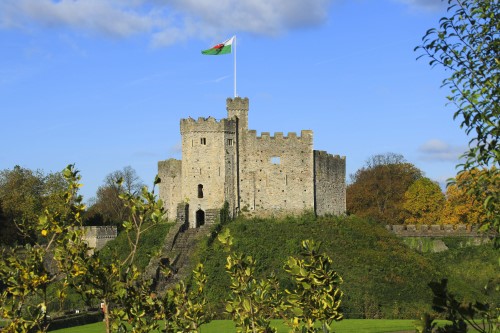
Cardiff Castle passed on to many noble families. In 1766 it came into the possession of the Bute family. The 3rd Marquess of Bute employed the architect William Burges to transform the castle interior into a fairytale Victorian Gothic residence.
In 1947 John Crichton-Stuart, the 5th Marquess of Bute, handed over the keys of Cardiff Castle to the Lord Mayor of Cardiff. In a philanthropic gesture the castle and the surrounding parkland was presented to the People of Cardiff.
HARLECH CASTLE
Harlech Castle is classed as a World Heritage Site. First built by Edward I of England in 1283 under the guidance of the King’s master mason, James of St. George, it is a fine example of a concentric medieval castle with imposing towers and a breathtaking location.
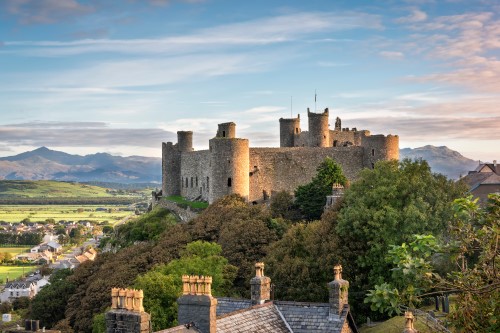
Over the next few centuries Harlech Castle withstood many attacks and sieges. In the 15th century it was involved in a series of civil wars known as the Wars of the Roses. In 1647 Harlech Castle surrendered to the Parliamentarians and from the 17th centuries the castle gradually fell into a state of disrepair.
In 1914 Harlech Castle was taken over by the Government and a careful restoration programme began. UNESCO considers Harlech Castle to be one of the finest examples of late 13th century and early 14th century military architecture in Europe.
CAERNArFON CASTLE
King Edward I built a string of castles along the north coast of Wales in order to control the Welsh population. Caernafon Castle was his most significant work led by his architect Master James of St George and work started in 1283. This fortress on the banks of the River Seiont took 47 years to complete and included town walls and a quay.
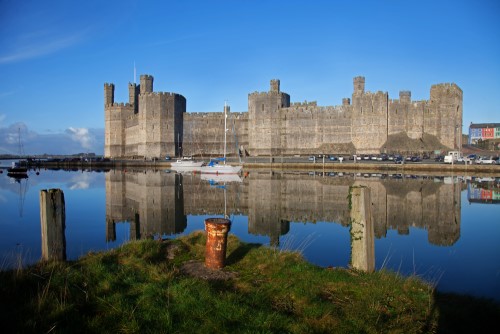
During the Civil War, Caernarfon Castle was held by the Royalists and Parliamentarians at various times. It finally surrendered to Parliament in 1645. When Charles II came to the throne in 1661 he ordered the destruction of Caernarfon Castle, which was fortunately never carried out.
The late Duke of Windsor, then Prince Edward, was invested at Caernarfon in 1911 in a ceremony masterminded by David Lloyd George, a Liberal Party Politician from Wales. A similar ceremony in 1969 saw Prince Charles, now King Charles III, proclaimed Prince of Wales.
Also a World Heritage Site and for sheer architectural might, Caernarfon Castle stands alone in its glory.
PEMBROKE CASTLE
Pembroke Castle sits on a well-chosen site that is almost a fortress itself, a mass of rock with precipitous sides plunging down to the tidal waters of the Pembroke River and Milford Haven. The irregular shape of the outer curtain follows the shape of the rock and it is protected by five large towers and a gatehouse
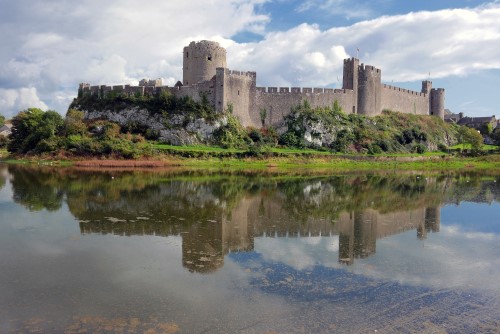
Pembroke's great round keep dominates both the castle and the surrounding countryside and it is also the only castle in Britain to be built over a natural cavern, a large cave known as the Wogan. No wonder the castle has featured in numerous films.
Pembroke was the birthplace of King Henry VII, father to the infamous Henry VIII and grandfather to Elizabeth I.
CAERPHILLY CASTLE
In 1268 Gilbert de Clare, Lord of Glamorgan, started to construct the biggest castle in Wales in order to take control of Glamorgan.
Built on a central island surrounded by artificial lakes Caerphilly Castle withstood many attacks thanks to its formidable construction of a concentric ring of walls, massive towers and huge gatehouses.
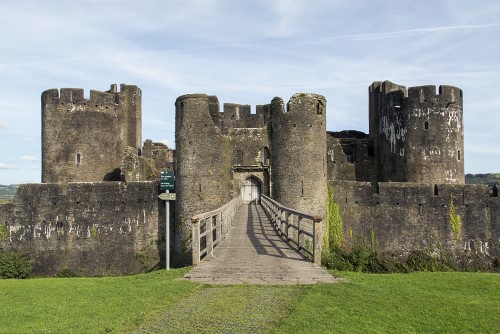
Gilbert de Clare died in 1295 with no obvious heir to the castle. As Caerphilly Castle lost its purpose to defend against enemies it fell into disrepair. In 1776 the castle passed into the hands of the Marquesses of Bute and vast renovations were finally undertaken by the 4th Marquess of Bute from around 1928.
Membership

A National Trust membership can pay for itself many times over if you enjoy exploring the heritage of Britain. Become a member today!

Free entry to over 400 historic places in England. Discounted admission to Historic Scotland and Cadw properties in Scotland and Wales. Join today!

Free entry to Historic Scotland sites including Edinburgh Castle and Stirling Castle. Discounted admission to English Heritage and Cadw properties.
Please support the work of Historic Scotland by clicking here.

Unlimited entry to over 100 historic sites across Wales. Discounted entry to English Heritage and Historic Scotland sites. Free entry to Manx National Heritage properties (Isle of Man).
Buy Membership | Buy Explorer Pass